Monday, November 13, 2006

BASKETBALL FEVER AND ONE MAN'S REMEDY


Nobody plays basketball with more passion, more commitment, than the young inmates locked-up in prison. Ask them and they’ll tell you they’re superstars, no one can take it to the hole like they can. Three meals a day, a warm place to shit, another warm place to sleep, and some yard activity and they’ll dribble that ball from sun-up to sun-down, or for however long the yard officers will allow. They’ll sacrifice learning how to read and write well, and don’t think for a red hot minute that they’ll take time out from their busy schedule to learn their multiplication tables either—it’s just not going to happen. Skipping school, even if it means risking a parole, is worth every minute of hoops. Short-term thinkers get long term punishments but who gives a hoot.

Once the snow hits, it’ll be time to move indoors. At Ryan Correctional, the athletic director invited some retired professional basketball players inside for a scrimmage. I remember the pregame warm-ups. The pros started with a standard two-line formation, one for lay-ups and the other for rebounding. On the other end of the court, you had a dozen balls flying from all angles at the basket with no rhyme nor reason. Total mayhem. Shock and awe, sapping any possibility of team play. Needless to say, the pros toyed with them, let them gain a sizable lead before picking them apart with a variety of set plays and the occasional slam dunk for emphasis.

Another time, our facility went into lockdown mode after an inmate spat on another inmate during a heated game. In order to make things right, in order to “save face,” both teams brought out their shanks and started running the gears. Maintenance had to dismantle the drinking fountain after someone bled in it while sipping water. Also, an inmate porter, trained in blood borne pathogens, proudly declared that he had cleaned up after the melee. I looked to see what time it was, “1430 hours.” The clock hung twelve feet high on the wall so no one could steal the motor and use it on a hobbycraft project. “How about there,” I said, nodding at the blood splatter on the clock.

But not all inmates shared the same passion for b-ball. There was this deputy warden, an ex-felon himself, paid his debt to society and went on to become a productive citizen, who believed in giving the inmates a cold-hearted reality check. He transferred to another facility and the first thing he decided to do to show the inmates that he had arrived, was to have maintenance cut down the basketball poles near the units. I’d heard this story from the inmates and chalked it up to modern day lore. When I transferred to the very same facility, I saw the asphalt filled holes where backboards were once erected and had to smile, simply had to.

Saturday, November 11, 2006

I LOVE LUCY

Last thing I want is another damn dog. You're talking at least a twelve year commitment. I'm as enthused as an inmate flushing his toilet when the Michigan State Police pay his cell block a visit with drug sniffing canines. Besides, it hasn't even been a week since Bear's death. Let me get through "Marley & Me" before we even discuss it. I'm a slow reader. Here's where I'm at: Poor John and Jenny Grogan came home to a shredded garage because Marley's afraid of thunderstorms. Do you really think I want to clean up after a puppy? Forget it!

So what does my wife do? Talk incessantly about our next dog. "When it's time, what do you think about a Sharpei-Lab mix?" Not now honey, we're still grieving over Bear. "Or should we get another Black Lab?" Enough with the dog talk already! After two days, I agree to let her peruse petfinder.com . Her doggy discussions increase twofold. She's even talking on the phone to various breeders. I try to ignore her. That's all she'll talk about. Dog this, puppy that. Once she has me worn down a bit more, she asks, "Would it be alright if I go to the Michigan Humane Society just to look?" Don't you bring a dog home. We've already went over this a thousand times. "Yeah, okay."

I speak to a coworker. He tells me when his dog died he made his family wait three years. "Damn, you're good," I say, "How'd you manage?" "Just keep saying 'no' no matter what tactics your wife uses. Don't give in." I'm afraid it's too late for that.

I come home from work and my wife's talking about a four month old Beagle-Pointer mix. I'm thinking of the added costs in upkeep. Veterinarian bills. Puppy chow. Dog crate. Accessories. She says the dog's name is Olivia, but she likes Lucy better. Great, she's already named her. My wife reminds me that her allergies will dictate which type of dog we get. Nothing's a done deal. "Alright alright alright, I'll go."

I should've never started reading Grogan's memoir about Marley. How could it be avoided? The book won the 2006 Quills Award for Best Biography/Memoir and the 2006 ASPCA Presidential Award. Grogan has two Children's Books and a movie deal in the works. I blame him. Dammit, it's his fault for softening me up. The above photo collage is Lucy and me. We've spent two days together. She's already housebroke and knows how to "kennel up." All she needs to do now is pass my wife's allergy test. My wife claims her eyes are itchy, her throat is scratchy. I ignore her. Leave us alone, I want to say, you might have to move out.

MY UNCLE JOHN


The last time I saw my Uncle John alive my mom was entertaining a rather large family visiting from Sweden. She had promised them a year earlier that they could stay at her house while vacationing. As she prepared a nice welcoming meal, my dad made the necessary trip to Ann Arbor’s U. of M. Hospital with my Uncle John hanging on tight from the back of his Harley.

My wife and I, my brother and sister-in-law, and all the Swedes got reacquainted in my mom’s walkout basement. Suzanne Andersen, a foreign exchange student during my college days, shared pictures of her new home and extended family. When my dad arrived, my mom went upstairs to see her brother. My dad whispered to my brother and I, “The doctor said there’s nothing more he can do for your uncle. The cancer’s too wide spread.” He suggested that we go visit with him.

I hadn’t seen my Uncle John in well over a year, so when I went upstairs I kept thinking—What can you possibly say to a dying man? I did the best I could, shaking his hand and greeting him with a “Hello Uncle John,” followed by a “you’re not doing so well, huh?” With very little energy left for conversation, he managed to say, “Not at all.” After a moment of awkward silence, I said, “Hang in there,” and left.

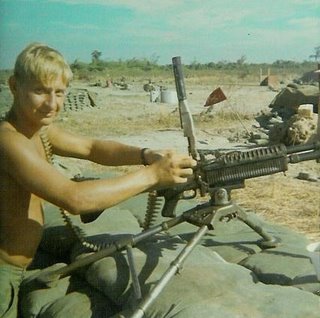
Three weeks later, after the Swedes departure, my Uncle John died. He was a Vietnam Veteran, serving his country at a very young age. He never spoke about the war, however, he sent letters home to my mom along with pictures.

In Sweden, every young adult male must serve their country for a mandatory two years. I often wonder whether our country should do the same. Today, we give thanks to our United State’s veterans for their dedication and commitment in protecting our country. We also remember those who’ve made the ultimate sacrifice so we can enjoy our freedom. God Bless.

Thursday, November 9, 2006

TRANSFERS GO BOTH WAYS

I’ve had my share of problems as an employee for the Michigan Department of Corrections, so when I was told by the Sergeant to close down my classroom and report to the Warden’s conference room immediately, all I could think was "here we go again." The year was 1994 and I was still a guppy trying to fit in, trying to learn all the nuances of dealing with inmates. Hey, it was them against us, we had to stick together, had to. Management even gave us Team Spirit pins and an official pep talk delivered on a general memorandum declaring "Team Work Makes The Dream Work."

Before I marched my timid self to the administration building, I popped my head into the principal’s office to see if she could enlighten me. My concerns deepened when she said she hadn’t a clue. After making a phone call, she claimed that maybe it had something to do with the recent ride-ins. I agreed. Two weeks prior, our facility received a Greyhound bus full of white convicts. My initial reaction had been Uh-oh, I’m not so sure this is going to work. You see, our facility housed predominately black inmates. Management had decided we needed a better racial balance, and as far as I could gather, it was because the few white inmates we had were always pleading to be transferred out. In no uncertain terms would the transfer coordinator show preferential treatment. Thus, bring in more whites.

Greeted by a long line of employees waiting to get into the Warden’s conference room, I asked the maintenance worker in front of me, "Hey, what’s going on?" He replied, "You don’t know? Take a look around." I’ve always known the Department of Corrections to hire a diverse staff, but when I stepped back, I saw only white male employees standing in line. The maintenance worker continued, "The EEOC is here to investigate reverse discrimination."

Here are some of the standard questions I was asked including my answers:

Q: How long have you worked at this facility?
A: Approximately two years.

Q: Who do you eat lunch with, white, or black employees?
A: Wherever there’s an available seat.

Q: Have you ever been passed up for a promotion based on your race?
A: I haven’t been here long enough to find out.

Q: Have you witnessed any tension among white and black coworkers?
A: Not really. But racial tension among the inmates seems to be increasing.

Unlike others, my interview ended rather abruptly. I started to wonder whether some of my fellow white coworkers were requesting transfers of their own. As for myself, I made a lateral transfer in 1997, having turned down the promise of a promotion.

ACME MEAT GRINDING CORPORATION

It’s not unusual for me to have students my father’s age or older studying for a GED. They’ll often complain that when they were on the "outs" they were making more money pressing car hoods than I'd ever dream of. I say, "Good for you, but did you ever learn a trade?" This usually puts them on the defensive. "I didn’t need to. The money was good enough." I often wonder what they mean by that, good enough for buying cheap beer at a premium price at the local watering hole? Good enough for liquor? Marijuana? Cocaine? Crack? What was it good enough for? To end up in prison?

I try to explain that you shouldn’t get too comfortable doing the same thing over and over. "Learn something new for a change and quit being so close-minded." My comments are unpopular. Someone always tells me about a family member with a college degree who can’t get a job—"all that education and for what?"

"Give me some paper," Mr. Snyder routinely greets me, "I ain’t got time for your shit. I gots work to do." Another older gent stands next to him, points toward my desk drawer. "Make yourself useful and get me some paper too."

They come to class early to get a premium seat in the back. Unlike the youngsters, they’re no trouble at all. Don't get me wrong, they hate attending class, but they’ll do whatever it is that you ask them to do. They’ll even lend some moral support by commenting about the youngsters in class not having worked a day in their lives. "You still got milk on your breath, son," Mr. Snyder says, ready to jab his knuckle into the chest of a youngster. "You ain’t weaned from the teat."

The youngsters hate being checked. They feel smarter, and indestructible. Most of them are willing to fight over any little comment. However, Mr. Lawton has channeled his energy elsewhere. He likes to draw amateurish cartoons in mock support of the old timers. He doesn’t realize that a good paying factory job is near extinction and that he should work on his academic skills. Even cleverness comes with a price. I show him his mistakes, thrusting my index finger toward his illustration. "You spelled ‘carefull’ and ‘anouther’ wrong."

Tuesday, November 7, 2006

FLEEING THE SCENE, A REENACTMENT

Some perspectives are hard to understand, especially if you’re on the inside looking out and the razor sharp concertina-wire doesn’t hinder your movement any more than the bloated sparrows preparing for flight with large chunks of bread from the inmate chow hall. "Where should we go for lunch?" You ask me, "Nevada Coney Island or Buddy’s Pizza?" It’s my turn to drive and for some odd reason, even though I’ve heard you, I’m deep in thought, replaying an old conversation with an inmate. Hey, he readily admits, if it hadn’t been for my imprisonment, I’d be dead by now, and I believe him, not because I’ve walked a mile in his shoes but because he was born and raised in Detroit, the very same city that permitted the state to build this safe-haven called prison. “Nevada’s fine,” I answer while thinking I have a much better chance of getting killed driving to and from work, than inside here. I’ve often thought about another commuter plowing into me by doing as I do, coasting through the four-way stops in the early morning hours as a preemptive strike against being car-jacked.

When we get to the employee parking lot, you notice tiny flecks of paint on my white Ford Tempo. You’ve complained about having them on your vehicle too. I shrug it off, my car’s older, less fancy, it’s really no big deal. “It’s permanent,” you say, sliding your index finger along the side panel, “it won’t come off. See.”

A week later on the way to work there's a shooting in the Pershing High School parking lot. The police cordoned off the street and strung yellow homicide tape near the entrance. Students mill about, casually jay-walking the street. I ease up on the gas pedal, careful not to hit any one. Hit and runs happen quite frequently in Detroit. "I’ll no longer be going out for lunch," I tell you.

Today the immobilization siren blares and the entire facility goes into lockdown mode. This is fairly common. However, we are not escorted to the administration building as usual. A desperate voice can be heard on the corrections officer’s radio, “We have three officers down, three officers down. There also appears to be two inmates down.” I’m none too concerned, thinking this is a practice drill, something we do on a monthy basis. They tell us nothing, absolutely nothing. Then an announcement, “Keep all windows and doors closed. Staff are not to go outside until further notice.”

You complain, "This is cutting into our lunch break." I look out the window, see two ambulances in the sallyport. Shortly thereafter, we’re informed of a chemical spill at the paint factory next door. They evacuated hours ago, but did not notify our facility. We are now given a choice: remain here or go home. Most of us choose the latter, knowing the inmates are locked in their cells waiting it out, knowing custody staff must remain also. I drive away, hoping to transfer some day to a prison out in the country.

A DIFFICULT DECISION

When Dr. Krysinski tightened the tourniquet and steadied the needle, I thought about my wife’s reaction to the nurse who gently touched her shoulder and said, “We do this procedure all the time, you have nothing to worry about.” My wife replied, “No, it’s not that. It’s … it’s …,” she reached for a Kleenex and dabbed her eyelids, “it’s the book.” She lowered her eyes toward John Grogan’s memoir “Marley & Me,” it’s spine unevenly balanced on her right knee. I, of course, was being rolled away on a hospital bed, the nurse pushing me through the double doors.

I do know this, my wife plowed through the first two hundred pages of “Marley & Me,” laughing and informing me of every bad incident that Marley, a Yellow Labrador Retriever, went through. “You got to read this,” she said. The last thing I wanted was to start reading a memoir about someone’s pet; I had better things to do with my day, or at least better things to read. “It’s been on the New York Times bestseller’s list forever,” she claimed, her way of saying, What’s the matter with you anyway?

Now, at this particular juncture, as Dr. Krysinski stuck the needle in, I remembered how difficult it was for my wife to finish the last few chapters on the day of my surgery. I guess it was then that I took an interest in what was going on. “Is Marley dying?” I asked. She nodded yes. A few days later, she finished the book, and gave it to me. I’m only on the fourth chapter, but let me tell you, John and Jenny Grogan, two young newlyweds, have purchased this dog, their hopes and dreams of his potential are as limitless as their love for one another. And so the story goes, each milestone Marley reaches is marked by something significant in their own lives. My wife and I certainly can relate to that. Our very own Bear started out as a guard dog, a square jawed British Black Labrador Retriever, a young pup with lots of energy and a nice disposition. Any little sound and he’d be charging at the door, barking his fool head off. But not anymore. We had a difficult decision to make. My wife looked into his eyes as they slowly closed and I felt his heartbeat slip away. We will miss him, may he rest in peace. And many thanks to the wonderful staff at Harvey’s Animal Hospital in Detroit.

IN MEMORY OF ...

Sunday, November 5, 2006

THE HUSBAND WORE PANTS

I’m a bit disappointed that my wife did not get absentee ballots for us, that way I could’ve filled out both ballots exactly how I wanted them, a sort of two for one deal, a perk for being the head of household. Marriage, after all, is a sacred bond between man and woman, and I’m sure she would cherish and obey my opinions and decisions. Take Michigan’s Civil Rights Initiative, otherwise known as Proposal 06-2, which, if passed, would ban public institutions from giving preferential treatment to groups or individuals based on race, gender, color, ethnicity or national origin. Sounds good to me. My wife, I’m sure, would agree that I’m right, that this proposal needs passing.

I’m sure Tekla Dennison Miller, the first female warden of Michigan, would agree to no preferential treatment too, even if it is a man’s world out there. In July 1971, when she applied for a job as a probation officer in Oakland County, the white male interviewer asked her the following, “Are you on the pill?” and she readily replied, “Have you had a vasectomy?” Needless to say, her interview did not go as planned. The interviewer explained that he was only concerned about her availability for the job and continued, “We also would like to interview your husband,” and she countered, “I didn’t know that (he) applied for this position.” This is how Mrs. Miller’s book, “The Warden Wore Pink” starts out. She tells it like it is. According to her, because of affirmative action, women have made great strides in choosing career paths that at one time seemed impossible. Excellent book by the way; Know a few people in it too.

So, are you thoroughly confused about the ballot language and my stance on it? Let’s just say this: If I vote “yes” on the proposal I get to reinforce the idea that it’s a man’s world out there, (white man to boot) and if I vote “no” I’m saying we need to keep affirmative action as it is. Either way, it’s a two for one deal for me. As long as I keep my wife happy.

Michigan Voter Information

Saturday, November 4, 2006

LEAVING PICTURES, DELETING POSTS


Most artists I know think their work is terrible; they are perpetually self-doubting and are extremely anxious. I’ve heard very few artists whom I know well say, "You’ve got to come and see this piece; it’s great." I usually hear, "This piece is horrible; it’s a disaster. Come tell me what to do with it." —Jennifer Bartlett


Robin, from R's Musings , asked me what I’ve learned from 6 months of blogging. Her question has been gnawing at me for days now. I’ve skimmed my various 180 posts, searching for answers, something perhaps witty or inspiring to say; unfortunately, I’ve come up with very little. Oh sure, it’s nice to reminisce after perusing past posts about my childhood and work experiences, and the photos certainly help, but this only deepens my uncertainty.

Why am I doing this? Why write? I’m sure I could find a less agonizing hobby. Then I tried to refocus, to become more positive. OK, I said to myself, there must be something, some tiny morsel of good, that has come from my blogging. Here’s what I came up with, Robin—brace yourself—four posts from June, July, August, and September, four posts that I absolutely believe in. In fact, I deliberately left off direct links because I’m thinking of deleting each one (I'll leave the pictures and titles) in hopes of making improvements and sending them off to various literary journals under the auspiciousness of nonfiction. I’ve never tried my hand at publishing nonfiction, so what the hell, it beats a stick in the eye.

So there’s my answer. Probably not the best explanation, but after 6 months, I believe in 2.2% of what I’ve written. Also, I’d like to congratulate The Thinker on her 100th posting. She celebrated with an amazingly perceptive theory on blogging, and I’ll admit, at sixteen, her answer is much better than mine.

Thursday, November 2, 2006

NOTHING GOES UNTOUCHED


Walking the wire is life. Everything else is waiting around.
—Karl Wallenda

Yesterday, I became a human rip-chord, my legs propped up on hard plastic stirrups, (and no, I wasn’t horseback riding). Just a simple little joy ride; no pressure at all. Except when the nurse, trained in Chinese water torture, filled my bladder with cold water; Except when the doctor performed his standard (but oh so invasive) cystoscopy.

"Was it the right kidney or left?" he asked while probing around inside me.

"Right," I gritted through my teeth, my lower back unforgiving, wanting to spring forward, if only I’d let go of the metal railings.

"Yes," he agreed, then disappeared.

"…"

"The stent’s out," the nurse said.

"I was afraid to ask," I responded.

"You can get dressed now. Remember to schedule your next appointment with the receptionist."

The fluorescent lights came on. The door shut. I got dressed and got the hell out of dodge. The day was still young, why not enjoy it?

Yes, I’m holding my stent—all eighteen inches of it. It’s bought and paid for. Also, I may have jarred loose my left kidney stone. Here it is under my digital microscope. Sorry for being so graphic. Perhaps I should’ve written a limerick instead.


There once was a man with a stent
Which made him walk with a bent;
The nurse dimmed low the light,
Doc pulled with all his might,
So it was done before he could vent.

Wednesday, November 1, 2006

TEMPORARILY OUT OF ORDER

You be me for awhile, and I’ll be you.
—The Replacements

I’ve been known to high-hurdle the Caution: Wet Floor signs in slow motion while an inmate porter drags a sour mophead across the tiled hallway floor. “Guess who I am?” I’ll ask the passerby’s, all wearing six-digit numbers stenciled on the backs of their shirts. For the most part, they give me that who gives a shit who you’re trying to be look. This doesn’t deter me. I toss them a hint. “Remember those Hertz rent a car commercials?” Still nothing. Perhaps they’re too young or I’m too old. I hammer them with my answer, “O.J. Simpson, man.”

Mocking the Juice doesn’t necessarily induced shits and giggles but you can tell he’s envied by a majority of the inmates. And why not? He beat his case, got a way with murder. “He was proven innocent in a court of law,” a jailhouse lawyer will argue. “How can you say he got away with murder when he was found not guilty of the crime?” Yeah, okay, Johnny Cochrane. If it doesn’t fit, you must acquit.

I’ve been known to poke fun of those inmates with “Temp” stenciled on their shirts, too. “So,” I’ll ask, “who’re you temping for?” As if they’re voluntarily filling in for someone and will soon be going home. Speaking of temporary: Perhaps someone could fill-in for me today. With eyes wide shut, my stent will be yanked out. The doctor’s temporary fix is no longer needed. I’ll be back to high-hurdling in no time.

Tuesday, October 31, 2006

CHARLIE AND JESUS

My mother-in-law always comes over for Halloween; It's tradition. She likes to give away our candy and comment on the various costumes. She even dresses up Charlie, her travel companion dummy. "He's a witch this year," she says enthusiastically.

"That's nice," I yawn.

In case you didn't know, I'm really not into the whole ghosts and goblins begging for candy at my door routine. I'd rather spend a quiet evening watching television, uninterrupted.

"You just missed the cutest little Elephant. He was adooorable, just adooorable."

My wife approaches and joins in, "Awwwh, look at the little Batman coming up the driveway."

"Hmmm," I say from the couch, ready to grab the t.v. remote and turn up the volume. I wish they'd sit on the porch, keep the door closed. I'm not trying to heat the outside.

So goes my night. Not all of their comments are favorable. My mother-in-law complains about a gaggle of teenagers breaking with tradition--no "trick or treat," no costumes, just pillow cases thrust forward waiting for some candy. As they walk down our driveway, my mother-in-law says, "They didn't say thank-you. I should've told them 'no costume, no treat.' They're too old to be trick or treating, don't you think? They should be at a Halloween party or passing out candy at home."

"How about a trick?" I ask. My wife and mother-in-law nod in agreement. I hit the key fob to my mother-in-law's van. Someone yells, "Jesus!"

TRICK OR TREAT


Our neighbor Pete had a prostitute living at his house, and when my wife informed me of this, I said, "Hey, at least someone's cutting the grass." The prostitute has long since disappeared and the grass and weeds are now matted down by a blanket of wet Maple leaves.

The children in our neighborhood know not to approach Pete's house, and Pete knows to leave his porch light off. Last year, for some odd reason, his mailbox spent more time in the ditch then standing erect at the end of his driveway. You see, Pete's a pedophile. Oh sure, he beat his case last year, but he still has teenagers coming over to buy weed and coke when school lets out.

Pete will seek me out whenever I'm walking our dog. He'll engage me in small talk by commenting on which breed of dog Bear is, or how the weather certainly has changed. He's been looking a bit haggard lately, like he's testing his product too much. One time, I found a rolled-up dollar bill near his house. I took it home and washed it off. Pete's no different than most of the inmates I deal with, not very bright.

Happy Halloween everyone. If you get the opportunity, read Bonnie Jo Cambpell's short story "Candy," which first appeared in The Ontario Review (issue No. 55). The allure of candy is just too much for some people.

Sunday, October 29, 2006

ANY SONG REQUESTS?


I told you I had a guitar. What would you like me to sing? How about Bon Jovi's "Wanted, Dead or Alive?" How about anything by Willie Nelson? Or Johnny Cash (except the song Erik mentioned)? How about something from the Cowboy Junkies? How about helping me out here?

HALLOWEEN TRAUMA (PART 2)

Here’s why mother’s shouldn’t let their sons grow up to be cowboys, or should I say dress them to be cowboys? Look! Just look at my outfit! Oh sure, at the time I was smiling. Wouldn’t you?—I’d just opened a present, the camera was pointed at me. But I think my smile was forced. Or at least I’m now wishing it were forced. I’m pretty sure I wanted to be a cowboy. A Clint Eastwood type of cowboy, not a Gene Autry type of cowboy! Not to be disrespectful, Mr. Autry did serve in World War II, but I’m not a musical type of guy. What happened to A Fistful of Dollars (1964), For a Few Dollars More (1965), The Good, The Bad, and The Ugly (1966), Hang’em High (1968), and The Outlaw of Josie Wales (1976)? I know, the last one was seven years after this photo, but so what—these were spaghetti westerns filmed in Italy and no one complained.

Now the complaints. Where’s my gun holster? Where’s my six-shooter? I’ll tell you where—there isn’t any! I had a guitar instead. I’m posing with it in another picture. My brother’s by my side. Guess what he is? A damned Indian Chief with complete headdress. Tons of feathers too. What was I to do? Shoot him with my six-stringer? Sing him to death?

So there you have it—another Halloween trauma. Like a Rhinestone Cowboy. Hell, I’d rather be in West World, a Malfunctioning Robot Cowboy, not a Village People “YMCA” Cowboy. I think you understand—a Macho Macho Man type of Cowboy! Or do you think I’m confused?

Friday, October 27, 2006

A GOOD MAN IS HARD TO FIND

Tell the truth, but understand that it is not necessarily what happened.
—Flannery O’Connor

If the Misfit in Flannery O’Connor’s “A Good Man Is Hard To Find,” were up for parole (prior to his escape), I’d be hard pressed to see the good in him. I’d have a hard time giving him the usual speech I give to any inmate willing to listen. “Remember when you were a child,” I’d start, “and you did something bad, I mean really really bad, and your parents were disappointed in you? Remember how awful you felt? Remember how you had to regain their trust? Think of the parole board in the same way, they’re your parents, they’re trying to see the good in you, your redeeming qualities, whether you’re worth placing back into society, whether you’re worth saving.”

Now I’ve had my share of inmates respond with, “Fuck the parole board,” but this here Misfit, he’d claim to have never been bad as a child. He’d acknowledge to having done something wrong, but he wouldn’t be able to tell you what it was; you’d have to read it from his case report.

Here I am, standing in front of Flannery O’Connor’s childhood home in Savannah, Georgia. My wife and I roamed the city, hiding our tourist stickers in our fanny packs, revealing them when we wanted the free trolley ride. We were on vacation and did not want to become victims, easy targets, to any of the misguided souls on the outskirts of the city. As if that mattered, you could spot the tourists from a mile away.

Not only do I admire Flannery O’Connor for her short stories, but her desire to make revisions demonstrates how truly devoted she was to her art. “Judgement Day” had been revised, made seven pages longer, after its initial publication twenty years earlier. How’s that for perfection?

Thursday, October 26, 2006

I HAVE A DEEP, DARK SECRET

In 1992, when a Catholic priest (the actual cousin of Guido Sarducci of Saturday Night Live fame) wished me well at our end of the school year luncheon, the other teachers, one by one, approached me. They pretty much said the same thing, “I didn’t know you were leaving.”

“Neither did I,” I replied. “I think I was let go.” Let go, at the time, seemed much nicer, had less sting, then saying, “Hey, I just got fired by a Catholic priest.” I can’t say I was shocked. Father Novelly and I never really did get along. I don’t think he really understood me, where I was coming from.

I remember taking my seventh grade class to the Saint Matthew’s Church for confession. This took valuable time away from instruction in the classroom, so I would count it toward the one hour of religion per week requirement forced upon me. I had asked another staff person, a teacher/nun why she couldn’t teach the religion class. She said, “Don’t you think I get enough religion?” I told her I hadn’t been to church in years, which only reinforced her beliefs that I was the right man for the job. Earlier in the school year I had surveyed my students. “How many of you are Catholic?” Seven hands reached skyward out of twenty-six. That meant nineteen of my students would have to sit in the pews, while seven others went to confession. It didn’t seem right to me. As my last student, Johnny, left the confessional booth (I had learned that the divider no longer existed, sinner and priest sat face to face) he said to me, “Father Novelly told me to tell you it’s your turn.”

I panicked. I’ll admit it. I hadn’t confessed my sins in at least a decade. I said to Johnny, “Tell Father Novelly that I’m not comfortable with the arrangement, afterall, he signs my paycheck.” The rest of the class started laughing. They got a kick out of my statement. Johnny entered the confessional, quickly came back out, and said, “Father Novelly said that’s okay.”

“What do you mean—okay? No, it’s not okay.” I said.

“For you to go in there,” Johnny said reassuringly, nodding toward the curtained booth.

I sent Johnny back into the confessional again. He didn’t come out right away. I sat with my students, wondering what was going on. Johnny reappeared after what seemed like eternity. He looked at me, and said, “Are we going back to the classroom?”

Yes. Yes we are. At least for the time being.

Wednesday, October 25, 2006

BROKEBACK MOMENT

You put your hand on my shoulder and spoke softly about the things you were going to do to me. I got nervous, felt your warm breath on the back of my neck. I shook my head, leaned forward, my way of saying, "I will have none of that." You felt my tension, said you’d be gentle with me down there, but when I questioned you further, you joked around, said you’d done this sort of thing before. Then I surprised you, personalized it, told you about the other guy, told you his name. "Yeah," I said, "he informed me of your gentle touch." You laughed, but did not reveal any information about him. You did not disclose any intimate details. "Don’t worry," you said, "You’re not going to feel a thing. Once I grab the end of the stent, I’ll tie it to the door knob, hold you tight, whisper sweet nothings into your ear, and kick the door shut."

At home my mother-in-law said I was making a big deal out of nothing. "He’ll numb it first. You’ll probably feel a slight tugging. Nothing more."

I tried to act brave. I jokingly said, "It has a name you know."

She laughed. I laughed. My wife rolled her eyes. I no longer have a stone in my right kidney. At least that’s what Dr. V told me. "But I never passed it," I said. He claimed that the lipthotripsy blasted it into sand. One more cystoscopy and I am done (right side anyway). Ironically, I’m most certain I saw the stone fragments after the doctor’s appointment. There had been a slight discoloration in my urine; sorry to wreck your fall traditions, but it looked like apple cider. As for you, Dr. V, "You can quit me any time."

Tuesday, October 24, 2006

HANGING LIGHTS, DREAMING FICTION


I have never thought of myself as a good writer. Anyone who wants reassurance of that should read one of my first drafts.
--James A. Michener


The first draft of anything is shit.
--Ernest Hemingway


I'm stuck in rewrite mode, untangling my thoughts, my ideas, my words, trying to string them together like the Halloween lights attached to plastic hooks on the gutters of my house. I've scooped up the clumps of damp wet leaves and thrown them to the ground, an added measure in preparation of the fast approaching winter months. Soon all those colorful leaves will have fallen, making for perfect mulch, a natural fertilizer, an insulator for growth to come.

I'm studying characters, new and old alike, introducing them to various situations, waiting for their reactions, waiting for them to pound on my door and offer up a trick or two. Sometimes what they do and say is too predictable, other times they're out of control, shocking me, making me beg for more. "Ok," I'll say, "What if I change your behavior with a swift stroke of the pen, will that make you more believable, will that make you not return to your old ways?"
And if the answer is "yes," it's okay not to believe them, as long as I keep an eye on their mannerism and know that certain situations may arise, bringing out the truth.

I've been blogging now for six months. Some days have been more productive than others. It's a learning process, a matter of continuing to move forward. Writing doesn't always mean publishing. I've learned that. I've also learned to be patient, something I've observed in the inmates who are doing more time than they actually have.

The only thing worse than a bad story, is a bad story published.
--JR Thumbprints